
Reflections on how AI is changing the way we shape experiences
There’s a moment that happens when you start working with AI seriously:
you stop thinking in terms of screens, and you start thinking in terms of intentions.
The interface becomes less important than the invisible layer that connects the user and the system — the space where meaning is negotiated.
This is where “Conversation Flow” enters the picture.
And to be honest, it’s not what most people think it is.
A lot of designers imagine that an AI conversation is just a chronological sequence of messages.
But the more you work with these systems, the more you realize how misleading that is.
A conversation flow is not a script.
It’s not a chatbot scenario.
It’s not even “UX writing”.
It’s a map of thinking.
It is the invisible structure that organizes how the AI interprets, questions, hesitates, adjusts, and finally acts.
It’s the choreography behind the scenes — and once you see it clearly, you understand that this is where the real design work is happening.
Today, we dive into that.
Not as technicians.
Not as prompt engineers.
But as designers who want to understand how intelligence moves inside an interface.
Start here to get the full picture
This is the article that sets the tone.
It gives you the big picture before diving into the rest.
Why Conversation Flow is not just another UX deliverable
When you think about a classic interface, the user has to adapt to your structure.
Your form, your fields, your required inputs.
But in an AI-driven flow, the opposite happens:
the system adapts to the user’s expression, confusion, shortcuts, and imperfections.
This creates a new responsibility for us:
we must design how the system behaves when the user is natural, human, messy, incomplete.
A conversation flow is simply our way of making this behavior visible.
And the more I study this craft, the more I feel like we’re drawing bridges between two minds:
one biological, emotional, intuitive — the user;
and one probabilistic, careful, analytical — the AI.
Designing this bridge is both a privilege and a challenge.
Where every conversation really starts
It starts with something very human:
an intention.
Not a button.
Not a flowchart.
A thought expressed in the simplest form possible.
“I want to renew my contract.”
“Order 30 A4 paper packs.”
“Prepare a draft email for my client.”
And everything the system does afterward is a dance around this intention.
From interpretation, to clarification, to confirmation.
This is why conversation flows feel almost alive:
they reflect the natural complexity of human communication.
The Map: How an AI Conversation Really Works
The “Intention → Interpretation → Clarification → Confirmation → Action” Map
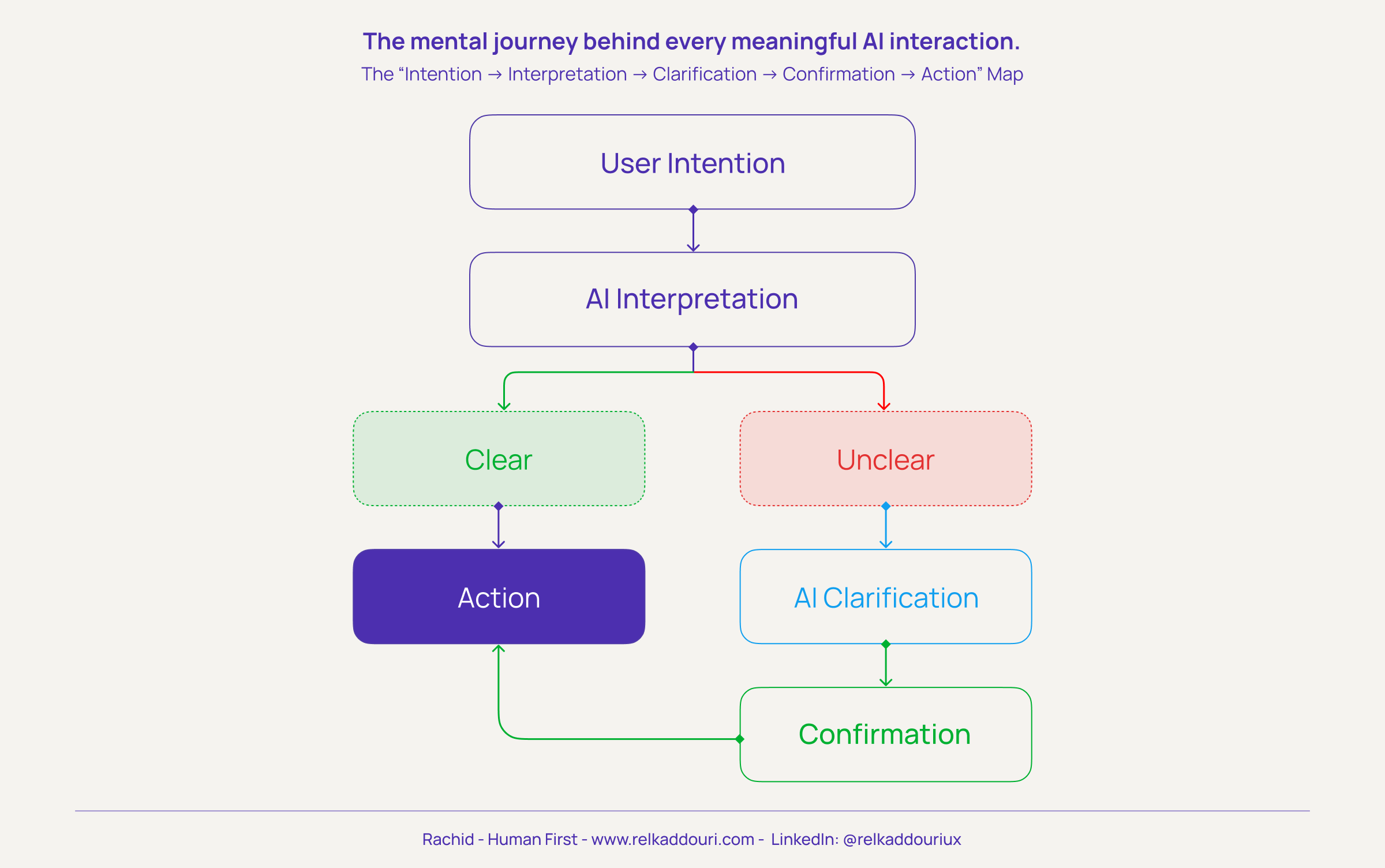
This is the core mental model of every intelligent interaction.
Not because it’s “mathematically correct”, but because it captures the essential movement behind the scenes.
The Three Paths — the part designers always overlook
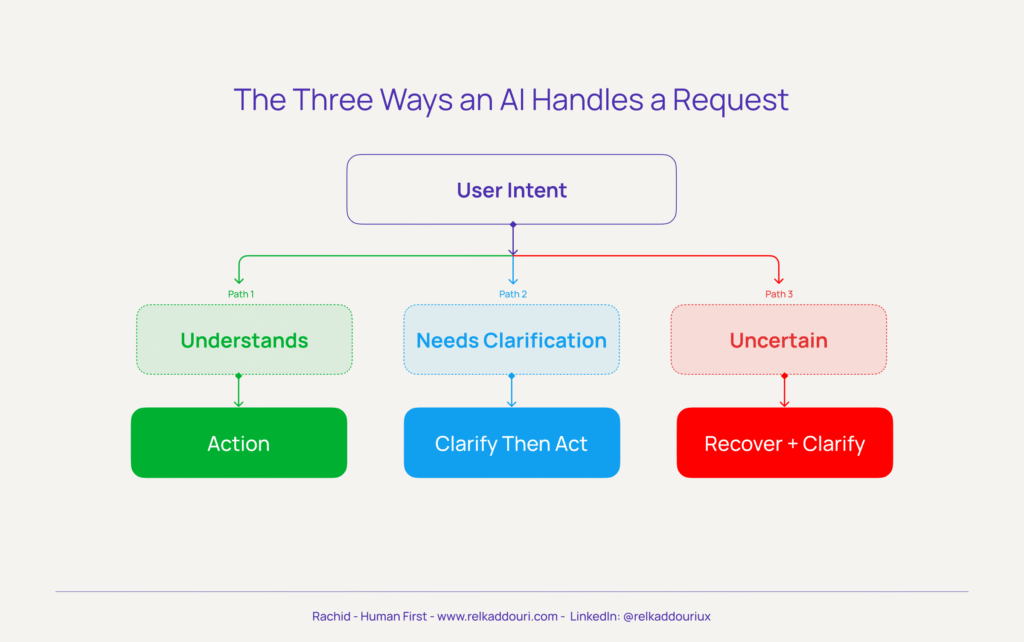
While studying many AI systems, I realized that almost every conversation follows one of three paths.
This helped me simplify my own design process dramatically.
Here they are:
Path 1 — The Natural Path (the AI gets it immediately)
The user expresses → the system understands → the task is done.
This is the “smooth” experience every team dreams of.
Path 2 — The Clarification Path (the system needs more)
The AI is not fully sure, so it asks:
“Which supplier do you want?”
“When exactly next week?”
“Do you prefer Option A or B?”
Not to block the user, but to stay aligned.
Path 3 — The Recovery Path (the system didn’t understand)
This is the most human moment.
The AI admits uncertainty.
It resets the context gently.
It tries again without losing the user’s trust.
These three paths form the skeleton of any AI flow.
The Three-Path AI Flow Model
A simple example to bring the whole thing to life
Let’s take the purchase request example again, because it’s universal and clear.
The user writes:
“Order 30 packs of A4 paper for next week.”
Here’s the real conversation the system must go through:
- The intention is captured
- The AI interprets the meaning
- It checks for missing variables
- It asks for the ones it needs
- It organizes the pieces
- It confirms
- It executes
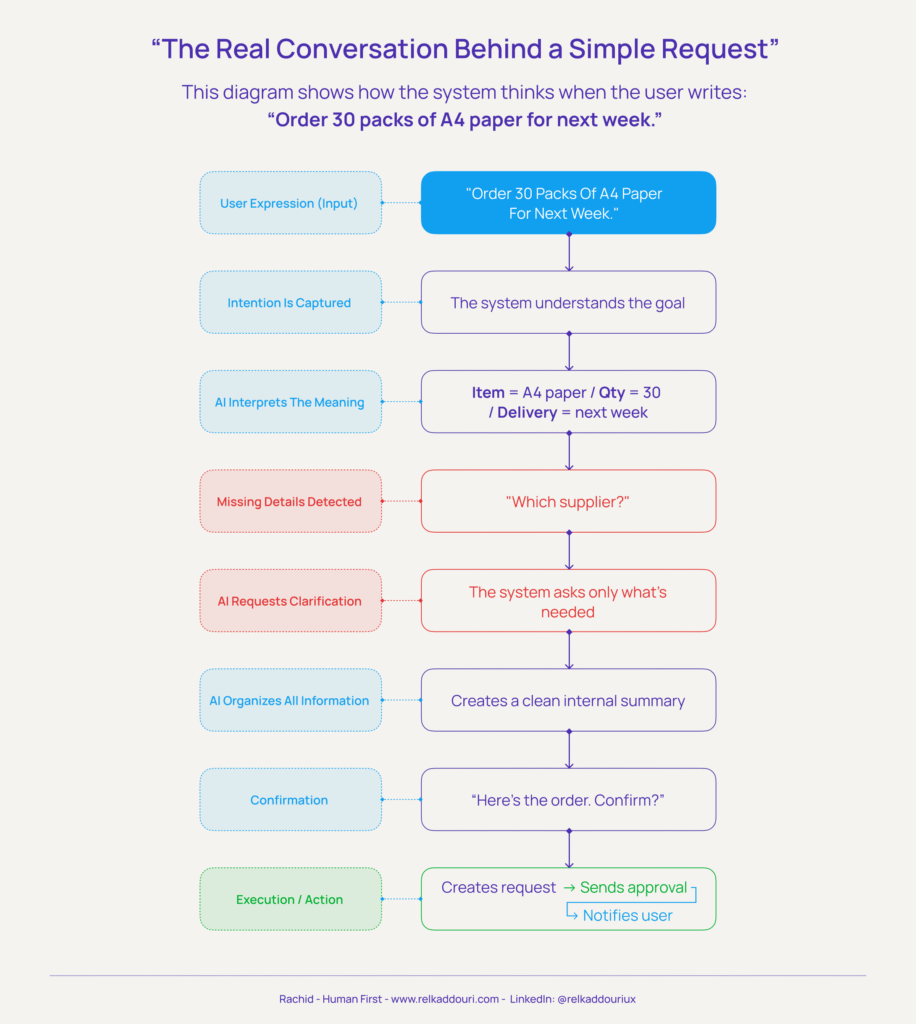
This diagram shows how the system thinks when the user writes:
“Order 30 packs of A4 paper for next week.”
This is not “automation”.
This is collaboration.
And once you see it this way,
you understand why designing AI experiences is a beautiful challenge:
we’re designing the mental behavior of a system that wants to help.